The Art of Showing Up: Why Mental Discipline Matters When Learning Bharatanatyam After 30
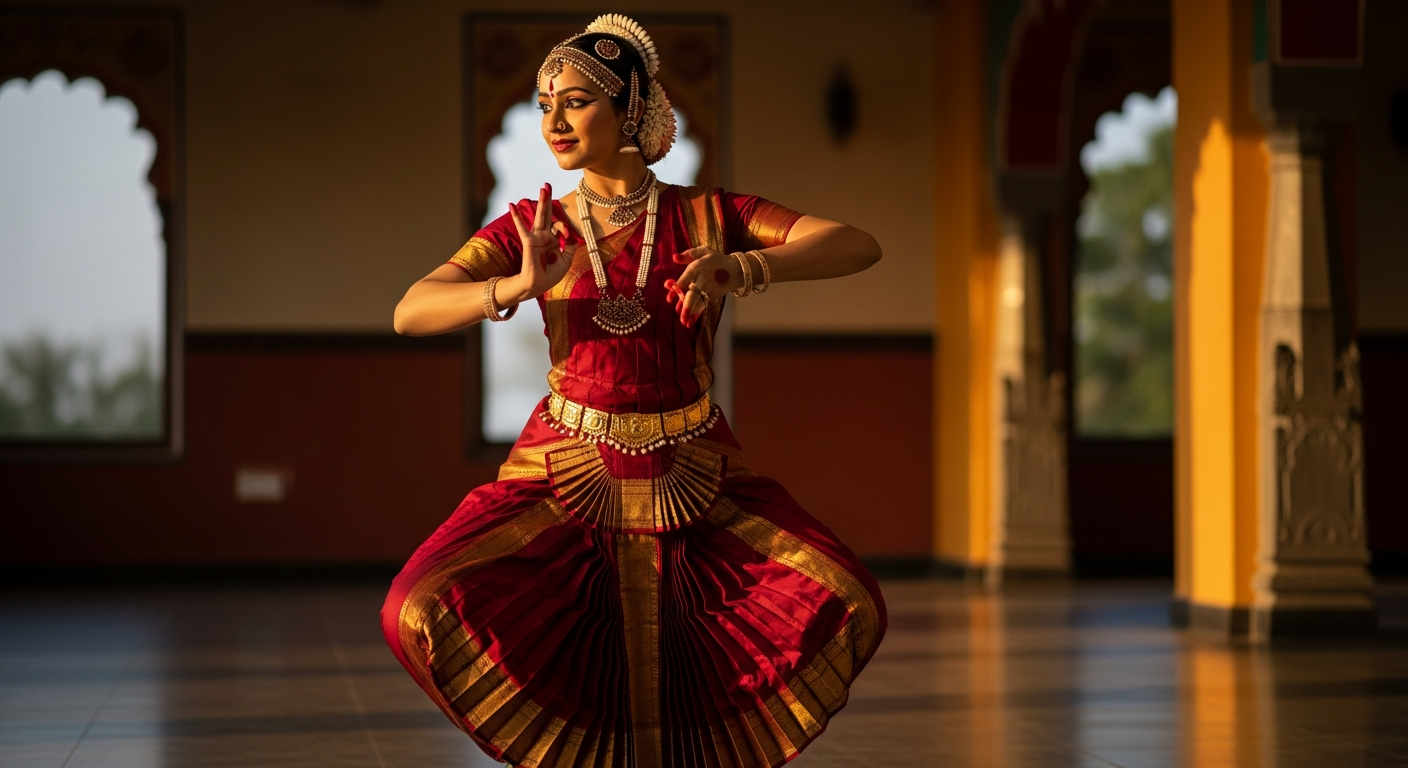
There's a particular moment I've witnessed countless times while teaching Bharatanatyam online to adult learners across the globe. It usually happens around the third or fourth month. The initial excitement has settled. Work deadlines loom. Family needs call. And suddenly, the practice that once felt like a gift begins to feel like one more obligation on an already overflowing plate.
"I'll get back to it when things calm down," they tell me. "Life is just too demanding right now."
I understand this completely. When you're learning Bharatanatyam after 30, you're not just learning a dance form. You're negotiating it alongside careers, partnerships, children, aging parents, mortgages, and the thousand small fires that demand your daily attention. The teenager learning in a traditional gurukul setting has the luxury of singular focus. You do not.
But here's what I've observed from training over a hundred students from more than 40 countries, many of them beginning this journey well into their thirties, forties, and beyond: the mental discipline required to sustain your sadhana isn't separate from your life. It becomes the foundation for everything else.
The Misconception of "When Life Calms Down"
Let me be direct: life will not calm down. There will always be a project, a crisis, a commitment, a legitimate reason to pause. If you're waiting for the perfect season of spaciousness to resume your practice, you're waiting for a myth.
What adult learners often don't realize is that Bharatanatyam, particularly when pursued with consistency, doesn't add to your burden. It reorganizes your capacity to bear it.
The physical practice builds stamina, yes. But the real transformation happens in the negotiation itself: choosing to show up when you don't feel like it, carving out fifteen minutes when you "don't have time," maintaining your rhythm when everything else feels chaotic. This is where the art form does its deepest work.
Understanding Sadhana vs. Hobby
There's an important distinction here that often gets lost in modern thinking. A hobby is something you do when you have extra time and energy. A sadhana is something you do especially when you don't.
Bharatanatyam, pursued with sincerity, functions more like any spiritual or physical discipline that shapes your inner and outer architecture. It's not about achieving performance-ready proficiency in record time. It's about what the consistent engagement does to your sharira (body), your manas (mind), your entire being.
The adavus you repeat week after week aren't just building muscle memory. They're cultivating ekagrata, one-pointed focus. The abhinaya you explore isn't just emotional expression, it's training in rasa, in holding multiple bhavas simultaneously, in embodying perspectives beyond your own. The rhythmic complexity of the jatis sharpens cognitive function in ways that translate directly to problem-solving, memory, and mental agility.
The Truth About Building Physical Capability
Here's something essential to understand: any kind of functional movement capability requires years of consistent practice to develop. This isn't unique to Bharatanatyam. Whether you're learning a martial art, training for endurance, or developing flexibility, the body needs time, repetition, and patience to internalize new patterns.
You cannot rush embodiment. You cannot shortcut the process of training muscle memory, joint mobility, and neuromuscular coordination. These transformations happen in their own time, at a cellular level, through sustained engagement.
What matters isn't how much time you devote in any single session. What matters is that you show up regularly. Ten minutes of focused practice daily will yield far more than occasional hour-long sessions separated by weeks of absence. The body learns through rhythm and repetition. It needs the regular stimulus to adapt, strengthen, and refine.
This is why treating your practice as an everyday activity, as routine as eating or sleeping, becomes so vital. Not because you need to become a professional dancer. But because the gradual accumulation of small, consistent efforts is how any sustainable skill develops. The nervous system requires this kind of steady input to create lasting change.
Aligning With What's Essential
When students tell me they lack time, what's often happening is they haven't yet clarified what's truly essential in their lives versus what's merely urgent or habitual.
You wouldn't skip brushing your teeth because work got busy. You don't abandon movement entirely because your calendar is full. Somewhere along the way, you've internalized these as non-negotiable. The question becomes: what else deserves that status?
This isn't about adding more to your life. It's about recognizing what genuinely sustains you and protecting space for it. Fifteen minutes of daily practice isn't a luxury. It's maintenance. It's tending to your physical capacity, your mental clarity, your connection to something larger than the immediate demands of the day.
In a world obsessed with instant results and measurable outcomes, there's profound value in committing to something that unfolds slowly. Bharatanatyam doesn't offer quick wins. It offers deep, cumulative transformation. But only if you stay with it.
Abhyasa: The Practice of Repeated Effort
The concept of abhyasa in yogic philosophy refers to sustained practice over a long period of time, without interruption, and with sincere devotion. This isn't about perfection. It's about persistence.
Every time you step onto your practice space when you'd rather rest, you're strengthening your capacity for self-discipline. Every time you complete a sequence when your mind is scattered, you're training sustained attention. Every time you return after a disruption, after illness, travel, or overwhelm, you're practicing resilience.
This is the hidden curriculum of learning Bharatanatyam as an adult. The dance itself is beautiful, transformative, profound. But what the commitment to learning it develops in you may be equally valuable: the capacity to choose your growth even when it's inconvenient, to honor your aspirations even when they're difficult, to show up for yourself with the same dedication you show up for others.
The Gift of Regular Practice
I often hear students describe their experience with Bharatanatyam as "becoming a new person." There is absolutely a transformation that occurs. But perhaps it's more accurate to say you're becoming more fully yourself. The person who has always contained this capacity for focus, for artistry, for disciplined engagement. The practice simply reveals what was already there, waiting for your attention.
But revelation requires consistency. Study after study confirms what practitioners have known for centuries: sustained engagement with classical art forms enhances neuroplasticity, emotional regulation, and executive function. For adults juggling complex lives, these aren't luxury benefits. They're practical tools that improve everything else you're managing.
The students I've worked with who maintain their practice through busy seasons don't just become better dancers. They become more focused in their work, more present in their relationships, more resilient in the face of challenge. The mental discipline you develop through sadhana doesn't stay confined to the practice floor. It goes with you everywhere.
Beginning Again, Right Now
If you're reading this and feeling the pull to return to your practice, or to finally commit to it with the steadiness it deserves, there's no better time than now. Not when your schedule clears. Not when you feel more ready. Now, in the midst of everything.
Start with what's manageable. Ten minutes of adavus. A single theermanam practiced with full attention. One session a week, protected consistently. Then build from there.
The key is daily contact, even if brief. Your body needs the regular reminder. Your mind needs the recurring anchor. The practice accumulates in ways that aren't always immediately visible, but over months and years, the change becomes undeniable.
The dance will teach you, but only if you show up to learn. Not perfectly. Not with endless time. Just regularly, with sincerity, with the understanding that this matters.
Because it does.
Rakshita Raghunathan is a Bharatanatyam dancer and teacher, founder of Samridhi Dance Foundation, with students from 30+ countries. Learn more at samridhidance.com
Ready to Begin Your Dance Journey?
Join Samridhi Dance Online and learn Bharatanatyam from the comfort of your home.